Le Plaid des Montagnes: The Spirit of Elevated Warmth
A new reading of alpine textile design

Reading the mountain without looking at it
A mountain cannot be understood at once.
It reveals itself through fragments, shifting surfaces, transitions that depend on light and distance. The longer one observes it, the more each section becomes a feature of the terrain: a ridge, a shift in slope, a stable plateau, a gentle descent.
A throw designed for altitude follows a similar logic.
It does not illustrate the mountain. It translates it.
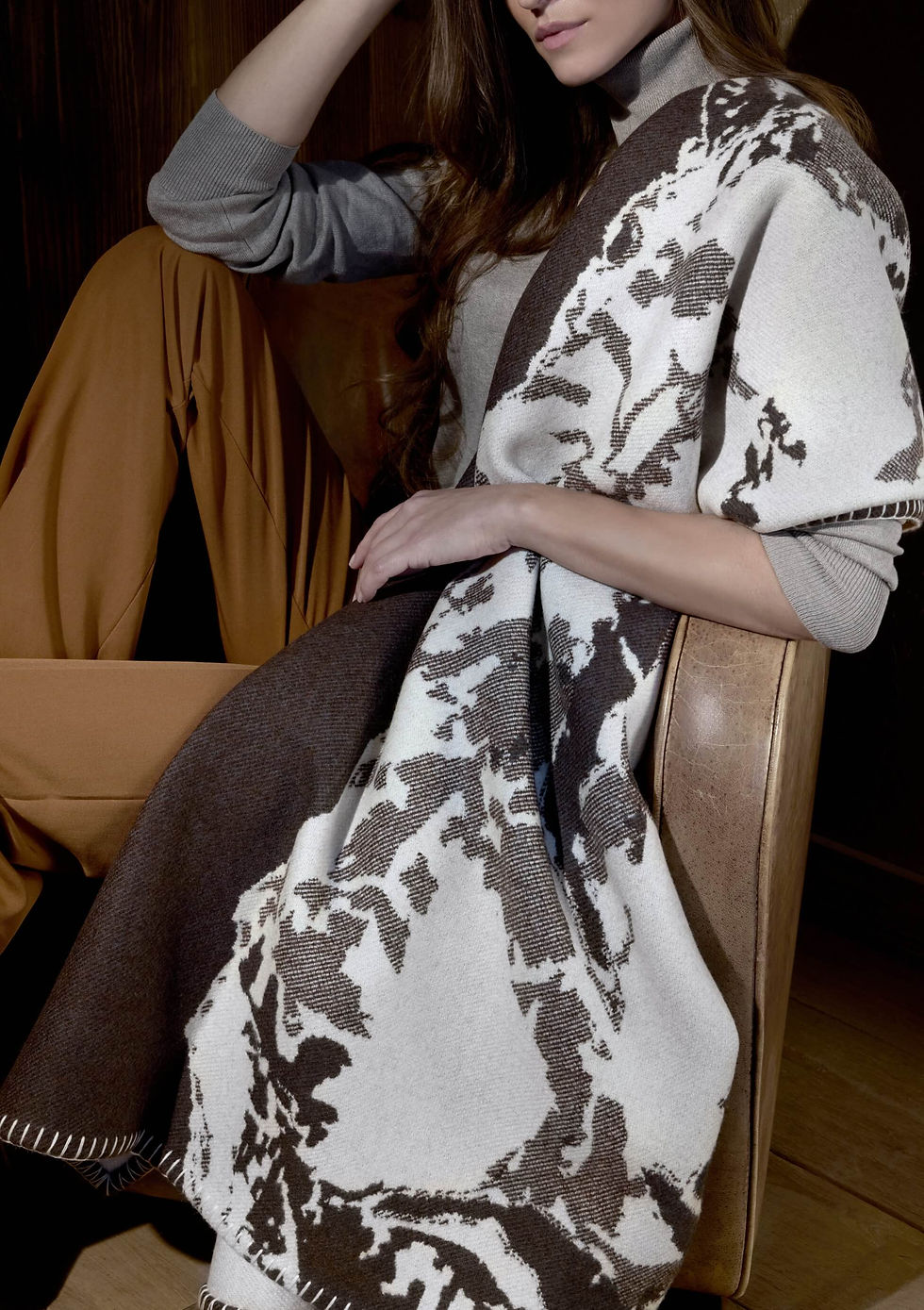
The surface becomes a small terrain of its own, something the hand can explore without borders or limits. One moves more slowly across it, sensing changes in tension, density and openness.
The plaid stops being a textile.
It becomes a landscape the fingers can read.
A textile topography
Relief appears whenever light encounters matter.
Within Le Plaid des Montagnes collection, this encounter turns into a quiet form of expression. Under raking light, the texture reveals a sequence of planes. Some lines suggest a shift in elevation, others a compressed zone that feels almost geological.

This way of shaping a surface is not decorative.
It encourages the hand to follow the textile as one would follow a path.
Certain sections are smooth. Others carry more presence. One moves across the throw as one moves across a mountain: through firmness, softness, transitions that form a coherent system.
The plaid becomes a familiar terrain.
A portable one, yes, yet one that carries the memory of altitude within its construction. The internal transitions echo the organisation of a natural landscape. Nothing is added for effect. Everything follows a quiet structural logic.
The alpine reference exists without imagery.
It passes through the fibre itself.
The micro-gestures of altitude
Mountains encourage concise gestures.
Shaking off moisture.
Adjusting a layer so it sits correctly.
Folding equipment in a compact way.
These movements have no theatrics. They are efficient and instinctive.
Le Plaid des Montagnes fits naturally into this vocabulary.
When pulled across the body, the textile reacts with clarity: it adjusts, aligns, settles into place. This responsiveness comes from the way it is constructed. There is discipline in its behaviour, not stiffness, but control.

One could watch someone handle this throw for several minutes.
The gesture would always feel exact: a slide of the hand, a lift, a small adjustment made without thought. The textile cooperates.
In an interior, this creates a bond between hand and material.
The plaid is not placed merely to fill a space. It behaves like an object one handles with the same attention given to a tool.
This precision gives the throw a presence that goes beyond softness or warmth.
It has a physical attitude shaped by the way it is used.
A textile instrument
In alpine environments, textiles have long been tools.
They were expected to resist, support, protect and adapt.
Le Plaid des Montagnes belongs to a different world, yet it retains this sense of function: a textile that behaves consistently, with clarity and stability.
Certain qualities echo this heritage:
A density that stays uniform across the surface
A response to folding that alters the perceived relief
A steady posture when placed on furniture

Such characteristics rarely appear in interior writing because they belong to a more technical understanding of textiles. Yet they give the plaid a distinct identity.
It is not simply pleasant to use.
It behaves with coherence.
Its construction can be sensed through the way it moves and settles.
A tool does not seek attention.
It seeks accuracy.
This quiet accuracy sets Le Plaid des Montagnes collection apart within the world of high-end textiles.
Colours shaped by the terrain
In the mountains, colours depend on distance and air.
A shade that seems stable changes with the hour or the angle of light.
The hues chosen for Le Plaid des Montagnes follow the same logic.
They are not static. They shift gently in daylight.
Some evoke the clarity of a ridge at morning.
Others resemble a sun-warmed stone or a shaded slope at the end of the day.
These tones are not meant to dominate a room.
They accompany it.
They offer a steady surface that adapts quietly to its surroundings.
Le Plaid des Montagnes in a contemporary interior

Le Plaid des Montagnes does not attempt to recreate a chalet atmosphere.
It avoids any nostalgic codes.
It fits naturally into contemporary interiors because it functions as a structured, disciplined object.
Placed on an armchair, it behaves like a well-crafted garment, with a controlled sense of volume and fall.
Folded neatly, it forms a compact textile block that recalls an architectural element.
Left slightly relaxed, it reveals softer transitions within the fibre.
In these spaces, the throw offers a sculptural presence.
It does not impose itself.
It creates a subtle point of stability that aligns with both modern and more elemental environments.
It can be moved freely without losing its coherence.
This is rare for a textile.
The Pulse
Every piece in Le Plaid des Montagnes collection carries a quiet pulse.
Not movement, but presence.
A way of sitting in the room, reacting to light, remembering a fold, settling back into its structure.
This pulse comes from the fibre itself: a textile that responds to the hand, that reveals new micro-reliefs as it shifts, that invites a slow reading through touch.
The mountain is not a theme here.
It is a method.
A way of organising matter, of designing an object that lives through its use.
Le Plaid des Montagnes reflects what Viñas Genève stands for:
clarity, discipline, precision, and a tactile intelligence that never seeks effect.
A textile that one does not simply place in a room.
A textile that behaves.
A textile that works the way a landscape works.
Quietly.
With intention.


Comments