Swiss Identity: The Story of Our La Poya Throw
When Tradition Becomes Fabric
In Switzerland, some images speak louder than words. The Poya tradition is one of them. This ancestral pictorial tradition, rooted in collective memory, depicts the spring ascent of cow herds to the alpine pastures. It is more than a naive decorative motif painted on chalet façades: it is a testimony of rural life, a celebration of community, and a ritual that still unites mountains and people today.

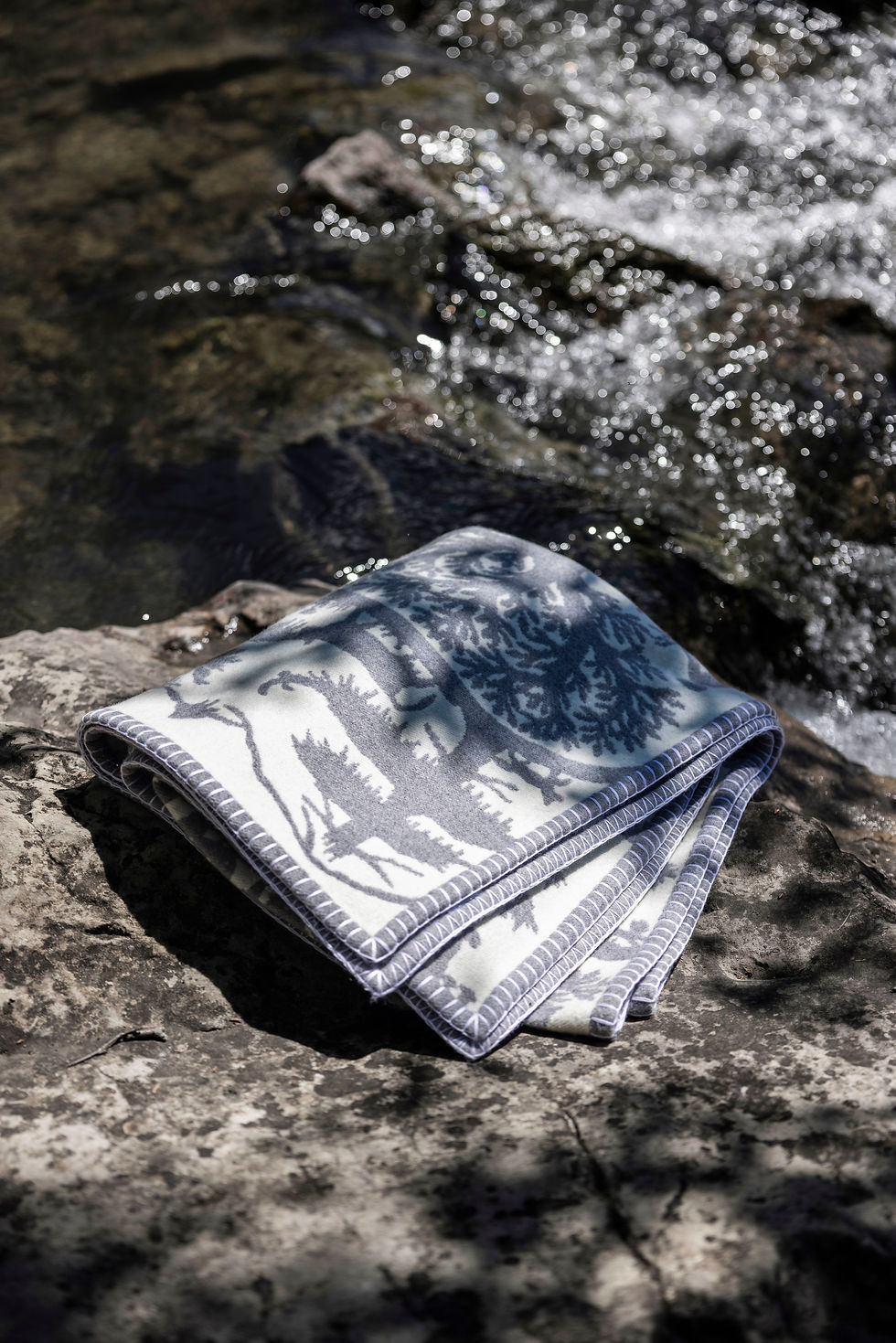
Through the La Poya Throw, Viñas Genève pays tribute to this artistic and artisanal heritage. Far from being a reproduction, the textile translates the spirit of the Poya into a living material: fine wool, spun and woven in Italy, yet imagined and designed in Switzerland.
The Poya: Memory of a Country
The word “Poya” refers to the precise moment of the year when herds leave the valley to reach the alpine pastures. Over time, this pastoral ritual has been represented on wooden façades as frescoes and painted panels, often in black and white or vivid colors. These works tell a story: cows led by armaillis, bells echoing through valleys, families accompanying the procession, mountains opening like a stage set.

It is not mere decoration. The Poya is a visual narration of Swiss communal life. Every detail matters: the leading cow, the armaillis’ gestures, the traditional costumes, the musical instruments, the alpine flowers.
A Recognized Folk Tradition
The origin of Poya painting dates back to the 18th century in the Gruyère region. The first creators were often peasants themselves, painting these long processions on their own chalets. The frescoes not only beautified façades but also affirmed the identity of the family and the village.
Today, some of these works have become emblematic. In Charmey, a dedicated museum preserves and exhibits historical pieces while showcasing contemporary artists who continue the tradition. In villages across Fribourg or the Pays-d’Enhaut, Poya frescoes can still be found on façades, as living witnesses of a cultural heritage deeply tied to the rural landscape.
The Link Between Poya and Textiles
Looking at these frescoes, I am always struck by their precision. The artists who painted them had no academic training, yet they possessed an artisan’s patience, a sharp eye for detail, and a determination to pass down collective memory.

In my textile work, I recognize the same discipline. Designing a throw is also about textile storytelling. Each line, each motif, each color must be right. Just as the Poya inscribes rural life onto chalet wood, a throw inscribes a story into fabric.
A throw is never only a blanket. It is a visual and tactile composition. It gathers gestures, memory, intention. The Poya expresses memory through paint; the throw expresses it through wool.
The Sensory World of the Poya
The Poya is more than an image: it is an atmosphere that awakens all senses.
Sound: cowbells of different tones forming a polyphony, mingling with the armaillis’ calls and traditional songs.
Scent: dry hay, damp earth on the mountain paths, warm wood of alpine chalets.
Sight: the contrast between colorful costumes, alpine flowers, and the dark silhouettes of herds.
Touch: the coarse fabric of costumes, the hammered surface of handmade bells, the carved wood of armailli staffs.
This sensory richness inspired the La Poya Throw. A fabric that envelops, carries the memory of seasons, and transmits the warmth of human gestures.
Craftsmanship and Continuity
The Poya is first and foremost handmade art. A brush on wood, a hand drawing lines. It is a process very close to mine: when we design a throw at Viñas Genève, everything begins with a gesture. Nothing is automated. The idea is sketched in Geneva, then takes shape in Biella, where weavers carry forward a savoir-faire refined over generations.

This dialogue between Swiss design and Italian craftsmanship, between tradition and modernity, prolongs the spirit of the Poya: inscribing daily life into an image or fabric that can be passed on.
The Poya as a Symbol of Unity
In a country marked by different languages, cantons, and customs, the Poya is a unifying tradition. It belongs to everyone, regardless of region. The cow, in Swiss imagination, is a collective figure: it nourishes, accompanies, and sets the rhythm of seasons.
This sense of togetherness inspired the La Poya Throw. It is not a solitary object. It is a fabric to be shared. Draped across a sofa, stretched over a table, passed from one shoulder to another. Just as the Poya gathers the village around the procession, the throw gathers households around a shared gesture.
Founder’s Perspective
I remember my first encounters with Poya frescoes, on chalets where they adorned façades like silent stories. They carried a quiet strength: the ability of a country to tell its traditions with humility, without need for embellishment.
When I began working on the Swiss Identity collection, it felt evident that the Poya should be part of it. It represents simplicity, continuity, memory. As a designer, I wanted it to live within a textile that could belong to contemporary life while remaining faithful to its origin.

This link between past and present moves me deeply: the Poya once painted on wood now becomes a motif in fabric. The spirit remains the same: celebrating what unites us, honoring tradition, transforming gesture into a durable image.
A Living Heritage
The Poya is not a relic of the past. Even today, Swiss artists continue this popular painting tradition. And the herds still climb to alpine pastures every spring. Bells ring out across valleys, and families still gather to accompany the procession.
Through the La Poya Throw, we aim to inscribe this living tradition into modern daily life. A throw is not a static object: it follows the seasons, passes through generations, and preserves the warmth of a home.
What We Carry Forward
The La Poya Throw pays tribute to Swiss rural traditions and their symbolic strength. It translates into fabric the memory of a country, the unity of a people, and the beauty of a pastoral ritual. At Viñas Genève, we believe memory is not only a story to be told: it is material to be passed on, a fabric to be shared.
The Poya reminds us that craftsmanship is alive as long as it has a place in daily life. The La Poya Throw is a bridge between yesterday and today, between frescoes painted on wood and textiles draped on a sofa or outside.
Final Image
Like a fresco that preserves the memory of a procession, the La Poya Throw preserves the warmth of a shared moment.

Comments